
Neodymium Magnets in Magnetic Bearings: Frictionless High-Speed Rotation
Introduction
In conventional rotating machinery, mechanical bearings—ball bearings, roller bearings, or journal bearings—support the shaft. But they all have one fundamental problem: friction. Friction causes wear, generates heat, limits speed, and requires lubrication.
Magnetic bearings offer a radically different approach. Instead of physical contact, they use magnetic fields to suspend the rotor in mid-air, completely eliminating mechanical contact. The rotor floats, supported solely by magnetic forces.
At the heart of most passive magnetic bearings are neodymium permanent magnets. Their exceptional strength allows the creation of stable magnetic fields capable of supporting rotating loads without external power.
This guide covers:
How passive magnetic bearings work
The critical role of neodymium magnets
Key design considerations and configurations
Real-world applications across industries
Advantages over conventional bearings
Part 1: What Is a Magnetic Bearing?
A magnetic bearing uses magnetic forces to support a rotating shaft without physical contact. There are two main types:
| Type | Description | Power Required | Key Component |
|---|---|---|---|
| Active Magnetic Bearing (AMB) | Uses electromagnets with feedback control | Continuous external power | Electromagnets + sensors + controllers |
| Passive Magnetic Bearing (PMB) | Uses permanent magnets only | None | Neodymium permanent magnets |
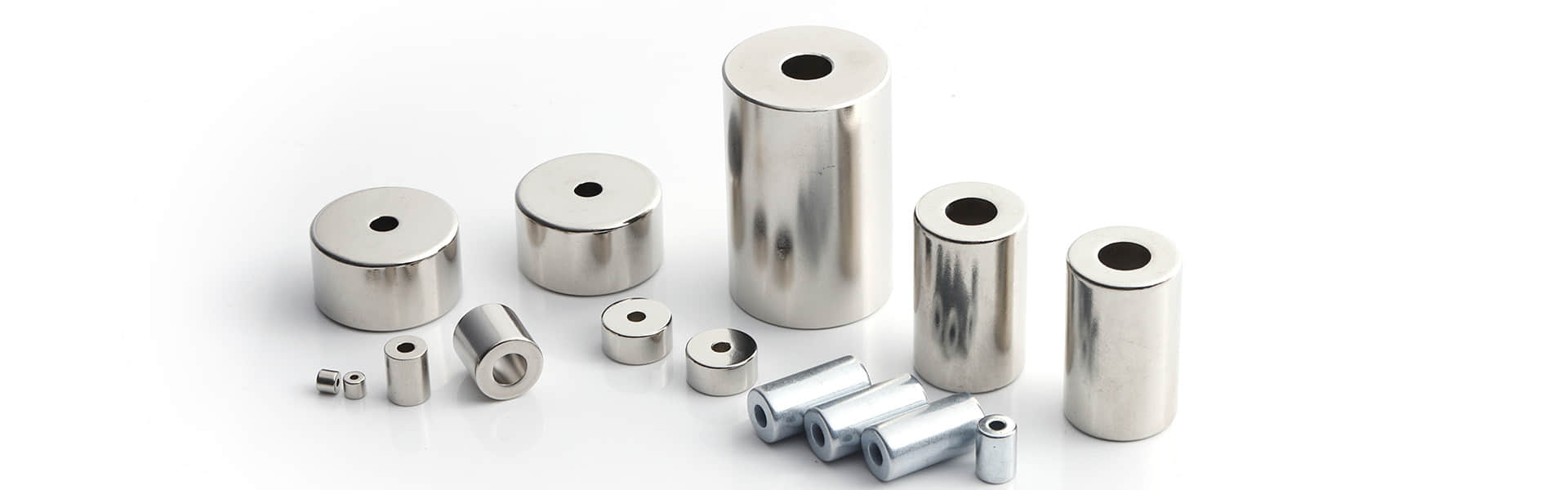
Passive magnetic bearings primarily comprise permanent magnet rings made from neodymium iron boron magnets, serving as the stator and rotor. Attraction or repulsion forces between these permanent magnets control their relative positions, maintaining stable suspension.
The neodymium advantage: NdFeB magnets provide the high energy product needed to generate sufficient levitation force in a compact package. Without neodymium, passive magnetic bearings would be impractical for most applications.
1.1 How a Passive Magnetic Bearing Works
A passive magnetic bearing typically consists of:
| Component | Material | Function |
|---|---|---|
| Stator magnet rings | NdFeB (fixed) | Creates the stationary magnetic field |
| Rotor magnet rings | NdFeB (rotating) | Follows the stator field, maintaining suspension |
| Steel housing | Low-carbon steel | Completes the magnetic circuit |
By varying parameters such as the size, shape, magnetization direction, and arrangement of the magnetic rings, different devices can be derived to suit various fields and applications.
Key principle: The bearing system does not include active control devices and does not require an external power supply. The magnetic field alone provides the levitation force.
Part 2: Why Neodymium for Magnetic Bearings?
2.1 The Strength Requirement
Magnetic bearings must generate sufficient force to:
Support the weight of the rotor
Resist radial and axial loads
Maintain stability during operation
Neodymium's advantage: NdFeB magnets have the highest energy product of any commercial permanent magnet material (30-52 MGOe). This allows compact bearing designs that can support significant loads.
| Magnet Material | Energy Product (MGOe) | Suitability for Bearings |
|---|---|---|
| Neodymium (NdFeB) | 30-52 | Excellent – compact, high force |
| Samarium Cobalt (SmCo) | 20-25 | Good – but expensive |
| Ferrite (Ceramic) | 3-4 | Poor – requires large size |
| Alnico | 5-8 | Poor – low coercivity |
2.2 Temperature Stability
Magnetic bearings often operate in demanding thermal environments. SH-grade neodymium (rated to 150°C) is typically specified for most industrial applications.
Research example: A study on a passive magnetic bearing for a turbocapander rotating at 80,000 rpm used two pairs of ring magnets made from neodymium (NdFeB) alloy magnet of Grade N42.
2.3 Magnetization Direction
The magnetization direction of the rings is critical:
| Configuration | Magnetization | Bearing Type |
|---|---|---|
| Axial | Through thickness | Thrust bearing (axial load support) |
| Radial | Across diameter | Journal bearing (radial load support) |
| Halbach array | Complex pattern | High-performance, compact bearings |
Halbach array advantage: By arranging magnets in a Halbach array, the magnetic field is concentrated on one side, improving bearing performance and reducing the amount of magnet material required.
Part 3: Advantages of Passive Magnetic Bearings
Power consumption comparison: At a speed of 10,000 rpm, passive magnetic bearing power consumption is approximately 15% of that of mechanical bearings.
Speed capability: Passive magnetic bearings allow rotors to operate at high speeds, primarily limited by material strength, enabling operation under supercritical conditions with speeds reaching hundreds of thousands of revolutions per minute.
Part 4: Key Applications
4.1 Medical Field – Magnetic Levitation Heart Pumps
| Requirement | How Magnetic Bearings Help |
|---|---|
| Long-term reliability | No wear, no lubrication failure |
| Low heat generation | Mechanical friction generates heat; magnetic bearings reduce this |
| Compact size | Small form factor for implantation |
| Low power consumption | Battery-powered operation |
Application detail: When using a heart pump to provide blood circulation power, mechanical friction can generate heat. Using passive magnetic bearings as a support system can enhance the stability of the heart pump during suspension, reducing heat generation.
A hybrid bearing support system combining radial permanent magnetic bearings and axial electromagnetic bearings allows the heart pump to feature simplicity in structure, compact size, and low power consumption.
4.2 Energy Industry – Wind Turbines
| Challenge | Magnetic Bearing Solution |
|---|---|
| Low wind speed starting | Reduced friction allows starting at lower speeds |
| Variable loads | Bearings adapt to changing wind conditions |
| Remote locations | No lubrication means less maintenance |
Application detail: Wind turbine magnets are important to wind turbines. Despite generating low torque at low wind speeds, rotor systems supported by passive magnetic bearings can still efficiently utilize low wind resources. The bearing system provides sufficient load capacity to cope with varying wind speeds and directions, thereby meeting system stability requirements.
4.3 High-Speed Turbomachinery
| Application | Speed Range | Benefit |
|---|---|---|
| Turbocapanders | 80,000+ RPM | Eliminates oil contamination |
| Compressors | 50,000-100,000 RPM | Maintenance-free operation |
| Flywheels | 30,000-60,000 RPM | Energy storage with minimal loss |
Research example: A passive magnetic bearing for a turbocapander rotating at 80,000 rpm uses two pairs of ring magnets of Grade N42.
4.4 Cleanroom and Semiconductor Manufacturing
| Advantage | Why It Matters |
|---|---|
| No lubrication | No oil mist or particle generation |
| No wear particles | Critical for semiconductor fabrication |
| Low maintenance | Reduces downtime |
Ideal applications: Semiconductor manufacturing equipment, pharmaceutical processing, and medical device manufacturing.
4.5 Aerospace and High-Precision Equipment
| Application | Benefit |
|---|---|
| Gyroscopes | High precision, no drift from wear |
| Reaction wheels | Long-life satellite attitude control |
| Precision instruments | Vibration-free operation |
Passive magnetic bearings serve high-tech industries such as semiconductor equipment, aerospace, high-precision and high-performance electric motors, and medical equipment.
Part 5: Design Considerations
5.1 Bearing Configuration
| Configuration | Load Support | Typical Application |
|---|---|---|
| Single ring pair | Axial or radial (one direction) | Simple thrust bearings |
| Multiple ring pairs | Axial + radial combined | Complete shaft support |
| Stacked rings | Increased load capacity | Heavy rotors |
| Halbach array | Optimized field distribution | Compact, high-performance designs |
Note: Passive magnetic bearings cannot actively adjust the magnitude and direction of magnetic forces like active magnetic bearings can. Moreover, rotors are susceptible to external disturbances, leading to instability or vibration; hence, they are typically used in conjunction with active magnetic or mechanical bearings.
5.2 Magnet Grade Selection
| Grade | Suitability | Why |
|---|---|---|
| N42 | Standard industrial bearings | Good strength, cost-effective |
| N45 | Higher load capacity | Stronger field |
| N42SH | High-temperature applications | 150°C rating |
| N52 | Compact, high-performance | Maximum strength |
5.3 Radial vs. Axial Bearings
| Type | Magnet Arrangement | Load Direction |
|---|---|---|
| Radial bearing (journal) | Ring magnets with radial magnetization | Supports radial (side) loads |
| Axial bearing (thrust) | Ring magnets with axial magnetization | Supports axial (end) loads |
| Combined bearing | Both radial and axial arrangements | Supports all directions |
5.4 Efficiency Improvement
Research finding: A study using N52 neodymium permanent magnets with the Halbach array method in a permanent magnet configuration showed that magnetic levitation bearings can reduce mechanical losses, thereby increasing DC motor efficiency by 4.23% and reducing operating temperature.
Part 6: Real-World Example – High-Speed Turbocapander Bearing
Application: Turbocapander rotating at 80,000 rpm
Bearing design:
Two pairs of ring magnets
Material: Neodymium (NdFeB) alloy, Grade N42
Configuration: Simulated to support axial load
Benefits achieved:
Eliminated oil lubrication system
Reduced maintenance frequency
Enabled higher operating speeds
No contamination of process gas
Part 7: Procurement Considerations
| Parameter | Requirement |
|---|---|
| Grade | N42 or N45 (standard); N42SH (high temperature) |
| Shape | Ring magnets (axial or radial magnetization) |
| Tolerance | ±0.05 mm on critical dimensions |
| Coating | Ni-Cu-Ni (standard) or Epoxy |
| Magnetization | Axial, radial, or Halbach array |
| Flux test | 100% testing, matched pairs |
| Temperature rating | Specify SH for high-speed or high-temperature applications |
Lead time: Custom ring magnets for bearings typically require 4-6 weeks including magnetization fixture design.
Conclusion
Neodymium magnetic bearings represent a paradigm shift in rotating machinery:
| Factor | Key Takeaway |
|---|---|
| Friction | Eliminated – zero mechanical contact |
| Speed | Hundreds of thousands of RPM possible |
| Power consumption | 85% less than mechanical bearings at 10,000 RPM |
| Maintenance | No lubrication, minimal wear |
| Lifespan | Theoretically infinite (limited by materials) |
Best applications:
Medical devices (heart pumps)
High-speed turbomachinery
Cleanroom environments
Aerospace and precision instruments
Wind turbines (low-speed starting)
The future: As neodymium magnet technology continues to advance, passive magnetic bearings will become increasingly common in applications demanding high speed, reliability, and cleanliness.
XiLaitech supplies custom neodymium ring magnets for magnetic bearing applications. We offer N42, N45, and N42SH grades with axial or radial magnetization, Halbach array configurations, and matched ring sets for precision bearing assemblies. Contact us for bearing magnet specifications.