
Neodymium Magnets in Underwater Engineering: From Diving Tools to Subsea Power Transmission
Introduction
The ocean covers over 70% of our planet, yet it remains one of the most challenging environments for human engineering. Saltwater corrosion, high pressure, zero visibility, and the sheer difficulty of access make underwater operations uniquely demanding.
In this harsh environment, neodymium magnets have become indispensable tools. Their exceptional strength-to-weight ratio enables applications that would be impossible with conventional magnets:
Diver-held magnets for hull inspection, debris removal, and equipment attachment
Magnetic couplings that transmit power through sealed housings for ROV thrusters
Underwater connectors that provide secure, quick-connect electrical and mechanical interfaces
Wave and tidal energy converters that harness ocean power without mechanical wear
This guide explores the diverse applications of neodymium magnets in underwater engineering, from simple diver tools to sophisticated subsea power systems.
Part 1: Diver-Held Magnets – Essential Underwater Tools
1.1 The Diver's Magnet
Commercial divers, hull inspectors, and underwater construction workers rely on powerful handheld magnets for a variety of tasks. These are not your average refrigerator magnets—they are N42 neodymium pot magnets capable of holding hundreds of kilograms.
| Feature | Typical Specification |
|---|---|
| Magnet grade | N42 neodymium |
| Holding force | 165–450 kg (360–1,000 lbs) |
| Coating | Epoxy or Ni-Cu-Ni for corrosion resistance |
| Design | Pot magnet with handle, eye-nut, and scraper attachment |
The MAM-003 underwater magnet, for example, has a holding force of 450 kg and can be used to fasten large devices such as oil booms or heavy diving equipment to ship sides and other steel structures. The magnetic component consists of neodymium coated with epoxy to improve its corrosion resistance in seawater.
1.2 Key Applications for Diver Magnets
| Application | Description |
|---|---|
| Hull inspection | Attaching inspection equipment to steel hulls |
| Debris removal | Retrieving ferrous objects from the seabed |
| Equipment attachment | Securing oil booms, diving equipment, and tools |
| Underwater surveys | Marking positions on steel structures |
| Search and recovery | Finding lost ferrous objects underwater |
Real-world example: A typical diving magnet features a N42 neodymium pot magnet with a support capacity of 165 kg and a breaking force of up to 200 kg, designed with input from commercial divers for inshore and offshore use. These magnets are essential for various underwater tasks, including inspections, hull work, and activities near mild steel structures.
1.3 Design Considerations for Underwater Magnets
| Factor | Consideration |
|---|---|
| Corrosion protection | Epoxy or Ni-Cu-Ni coating is essential for seawater exposure |
| Post-use care | Freshwater rinsing after seawater use is recommended |
| Pull force vs. application | Breaking force ratings assume clean, flat mild steel surfaces |
| Handle design | Must be ergonomic for use with diving gloves |
| Buoyancy | Magnets are heavy; divers must account for weight |
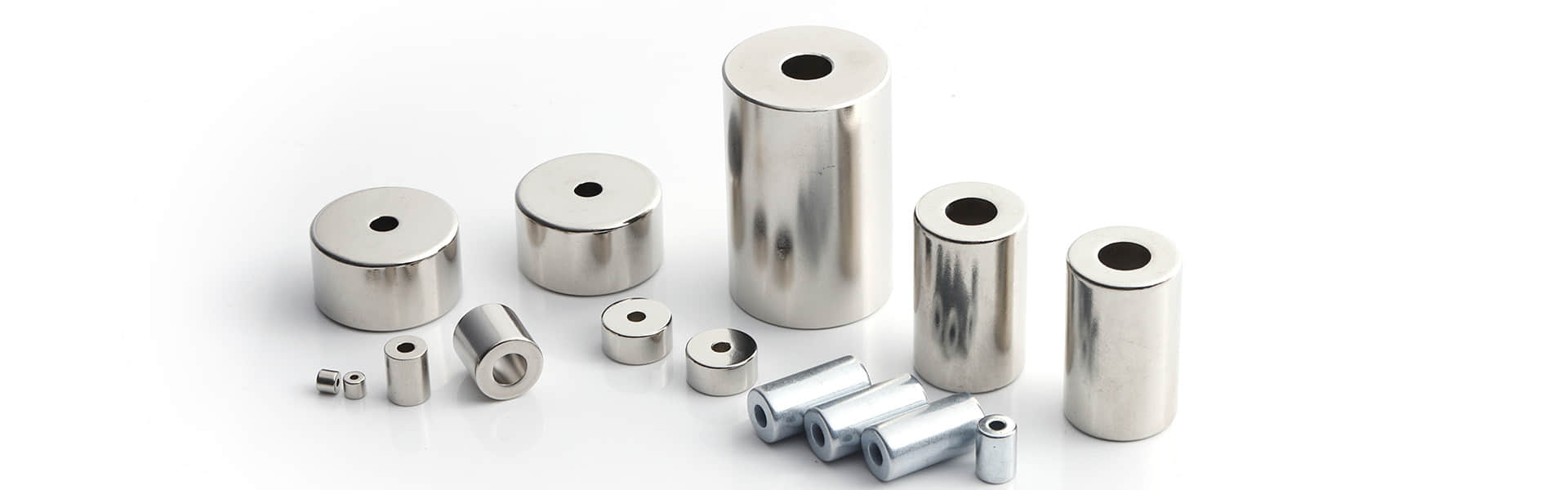
Pro tip: For extreme underwater conditions, BMAG offers epoxy-coated ring magnets with a robust resin coating that encapsulates the ring, preventing any moisture from reaching the NdFeB core, with tolerances maintained at 0.02 mm.
Part 2: Magnetic Couplings for Subsea ROVs and Manipulators
2.1 The Sealing Challenge
One of the greatest challenges in underwater robotics is sealing the motors that drive thrusters and manipulator joints. Traditional shaft seals eventually leak under high pressure, allowing seawater to enter and destroy the motor.
Magnetic couplings offer an elegant solution: torque is transmitted through a sealed barrier using neodymium magnets, eliminating the need for a physical shaft penetration.
2.2 How a Magnetic Coupling Works in a Subsea ROV
| Component | Function |
|---|---|
| Inner rotor (with NdFeB magnets) | Connected to the motor inside the sealed housing |
| Sealed barrier | Thin-walled non-magnetic housing (titanium, stainless steel, or plastic) |
| Outer rotor (with NdFeB magnets) | Connected to the propeller or manipulator joint outside the housing |
Operation: The motor spins the inner rotor; the magnetic field passes through the sealed barrier; the outer rotor follows synchronously—transmitting torque without any physical penetration of the housing.
2.3 Advantages for Underwater Robotics
| Advantage | Why It Matters |
|---|---|
| No dynamic seals | Eliminates the primary failure point in underwater motors |
| Pressure-tolerant | Works at any depth (housing strength is the only limitation) |
| No leakage | Protects sensitive electronics from seawater |
| Low maintenance | No seal replacement needed |
| Overload protection | Coupling slips if propeller jams, protecting the motor |
Research example: Researchers have been developing joints for underwater manipulators using magnet couplings with neodymium magnets, which are the strongest permanent magnets available. A sealed thruster for an underwater ROV using this technology is reliable to a depth of ten feet.
2.4 Magnet Specifications for Subsea Couplings
| Parameter | Typical Requirement | Why |
|---|---|---|
| Grade | N42 or N42SH | High strength + temperature stability |
| Coating | Epoxy (encapsulated) | Complete moisture protection |
| Configuration | Radial ring magnets | Efficient torque transmission |
| Temperature rating | SH for deeper/hotter environments | Maintains field under load |
The BMAG solution: Epoxy-coated ring magnets are the ultimate solution for underwater sensors and marine-grade motors, with the robust resin coating preventing any moisture from reaching the NdFeB core.
Part 3: Underwater Magnetic Connectors
3.1 The Need for Quick-Connect Underwater Interfaces
Subsea operations often require temporary electrical or mechanical connections—for ROV tool changers, underwater sensors, or offshore platform equipment. Traditional connectors require complex mating procedures and are vulnerable to contamination.
Magnetic connectors use neodymium magnets to provide:
Self-alignment – magnets guide the connector into proper position
Secure attachment – strong magnetic force holds the connection
Quick release – easy to disconnect when needed
Waterproof sealing – IP68 or higher ratings
3.2 How Underwater Magnetic Connectors Work
| Component | Function |
|---|---|
| Neodymium magnet cores | Provide the attractive force for alignment and retention |
| Encased housing | Completely seals the magnet from seawater ingress |
| Electrical contacts | Transmit power or data once mated |
| Sealing mechanism | O-rings or gaskets maintain waterproof integrity |
Real-world example: An electrical connector for offshore applications uses four neodymium magnet devices arranged in the connector housing. When applied to a cleaned metal surface (such as an oil platform leg), the neodymium cores are strongly attracted and settle on it.
3.3 Applications
| Application | Description |
|---|---|
| Offshore oil rigs | Temporary connections for inspection equipment |
| Underwater robotics | Tool changers for ROVs |
| Subsea sensors | Quick-deploy monitoring equipment |
| Military operations | Rapid deployment underwater systems |
Part 4: Neodymium Magnets in Marine Renewable Energy
4.1 Wave Energy Converters
Ocean waves represent a vast, untapped renewable energy resource. Many wave energy converters (WECs) use neodymium permanent magnets in their generator systems.
| Technology | Neodymium Application | Advantage |
|---|---|---|
| Linear generators | NdFeB magnets in the translator | Friction-free operation |
| Direct-drive systems | Permanent magnet generators | No gearbox, higher reliability |
| Point absorbers | Magnets in the buoy mechanism | Compact, efficient design |
Research example: A wave energy converter design comprises three axially levitated NdFeB permanent magnets, each coupled to an independent copper coil, forming a compact, friction-free generator column. This eliminates sliding components that are prone to wear—a common failure point in conventional wave energy systems.
4.2 Tidal Energy
Tidal currents are predictable and powerful. Neodymium magnets are being explored for novel tidal turbine designs.
Innovative approach: A novel application of tidal energy uses two opposing repelling neodymium magnets to operate tiny underwater turbines, harnessing ocean currents for sustainable energy. By leveraging magnetic repulsion, the magnets—embedded in or mounted on turbine blades—increase magnetic interaction and generate a strong repulsive force that accelerates rotation.
4.3 Why Neodymium for Marine Energy?
| Property | Benefit for Marine Energy |
|---|---|
| High flux density | Enables compact, efficient generators |
| Corrosion resistance (with coating) | Survives saltwater exposure |
| No mechanical contact | Eliminates wear in wave/tidal conditions |
| Long life | 20+ year design life for offshore installations |
Part 5: Magnet Specifications for Underwater Applications
5.1 Coating Selection
| Coating | Suitability for Underwater | Notes |
|---|---|---|
| Epoxy (fully encapsulated) | Best | Complete moisture barrier, ideal for saltwater |
| Ni-Cu-Ni | Good for short-term immersion | May corrode if coating is scratched |
| Parylene | Excellent | Conformal coating, low outgassing |
| Rubber overmold | Excellent | Complete encapsulation, adds impact protection |
Recommendation: For any underwater application involving prolonged saltwater exposure, epoxy-coated or fully encapsulated magnets are essential.
5.2 Grade Selection
| Grade | Suitability | Why |
|---|---|---|
| N42 | Standard underwater tools | Good strength, cost-effective |
| N42SH | Deeper or warmer applications | 150°C temperature rating |
| N45 | High-performance couplings | Higher torque density |
5.3 Post-Use Care
| Practice | Why |
|---|---|
| Rinse with fresh water | Removes salt that can attack coatings |
| Dry thoroughly | Prevents moisture trapping |
| Inspect coating | Check for scratches or damage |
| Store in dry environment | Extends magnet life |
Conclusion
Neodymium magnets are essential enablers of underwater engineering:
| Application | Why Neodymium is Essential |
|---|---|
| Diver tools | High holding force in compact, handheld packages |
| Subsea ROVs | Magnetic couplings enable sealed, reliable thrusters |
| Underwater connectors | Self-aligning, secure, quick-connect interfaces |
| Marine renewable energy | Enables friction-free wave and tidal generators |
Key takeaways for engineers and buyers:
| Factor | Recommendation |
|---|---|
| Coating | Epoxy or fully encapsulated for saltwater |
| Grade | N42 for most; N42SH for demanding conditions |
| Post-use | Freshwater rinse after seawater exposure |
| Design | Consider buoyancy and handling for diver tools |
XiLaitech supplies neodymium magnets for underwater applications, including epoxy-coated pot magnets, custom ring magnets for subsea couplings, and fully encapsulated assemblies. Contact us for marine-grade magnet specifications.