
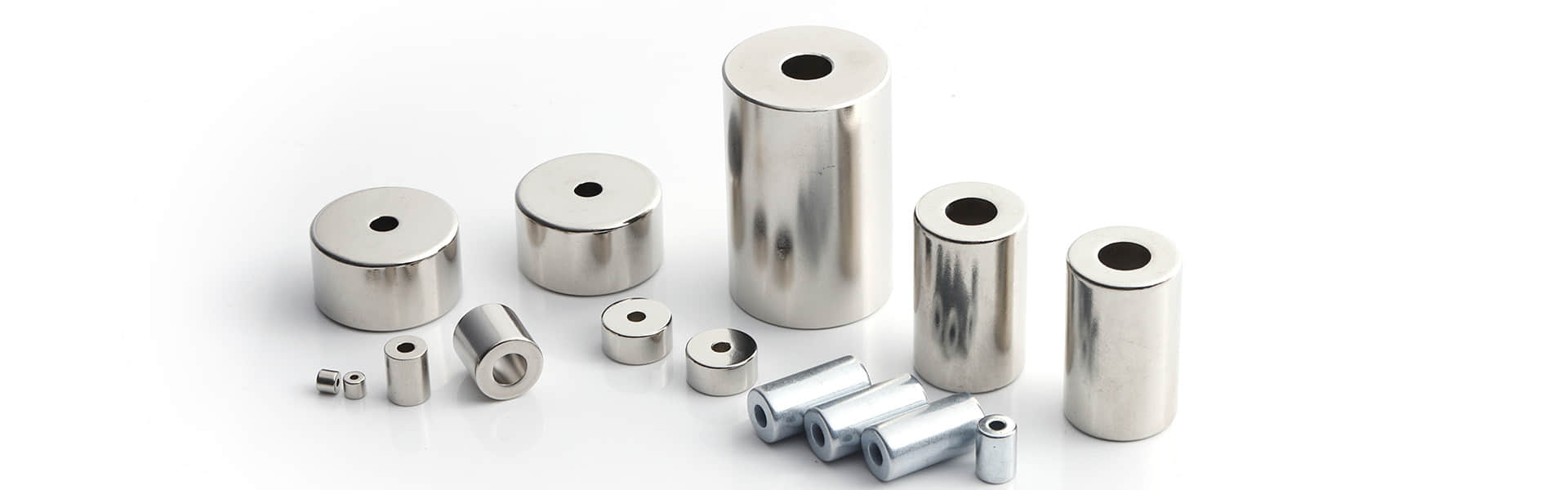
Neodymium Magnets in Consumer Electronics: Headphones, Haptics, and Miniature Motors
Introduction
Every time you put on a pair of high-fidelity headphones or feel your phone vibrate, you're experiencing neodymium magnets at work – shrunk down to millimeter sizes.
Consumer electronics demand magnets that are small, precise, reliable, and cost-effective at high volumes. A smartphone might contain 5-10 tiny neodymium magnets, while a pair of premium headphones uses two powerful rings.
This guide covers magnet applications in:
Headphone drivers (dynamic and planar magnetic)
Haptic actuators (linear resonant actuators)
Miniature vibration motors (ERM and coin type)
Design constraints for mass production
Part 1: Headphone Drivers – Where Sound Meets Magnets
Two main technologies dominate headphone drivers: dynamic (moving coil) and planar magnetic.
1.1 Dynamic Headphone Drivers
Most headphones (from 20earbudsto1,000 studio cans) use dynamic drivers. A neodymium magnet (or ring) creates a static magnetic field. A voice coil attached to the diaphragm moves when current flows, pushing air to create sound.
Magnet configuration:
Single magnet behind the coil (on-ear, earbuds)
Ring magnet around the coil (over-ear, higher-end)
Opposing magnets (push-pull) for improved control
Typical magnet specifications:
| Parameter | Value | Notes |
|---|---|---|
| Grade | N35 to N52 | Higher grade = stronger field = louder without more power |
| Shape | Disc or ring | Ring for over-ear; disc for earbuds |
| Diameter | 6-50 mm | Larger driver needs larger magnet |
| Thickness | 1-5 mm | Thicker = more field but heavier |
| Coating | Ni-Cu-Ni or gold | Gold for corrosion resistance (sweat) in earbuds |
| Magnetization | Axial (through thickness) | North-south through the flat faces |
Case example – Premium over-ear headphone:
Driver size: 40 mm
Magnet: N52 ring, OD 40mm, ID 20mm, thickness 3mm
Result: 110 dB sensitivity, 32 ohm impedance
1.2 Planar Magnetic Drivers
High-end headphones (Audeze, Hifiman) use planar magnetic technology. A thin, flat diaphragm with embedded conductive traces sits between two arrays of neodymium bar magnets (one on each side). Current through the traces interacts with the magnetic field, moving the diaphragm.
Magnet requirements for planar magnetic:
Shape: Rectangular bar (e.g., 20x5x3mm)
Quantity: 10-30 bars per side (20-60 total per headphone)
Grade: N42 or N45 (N52 too expensive and unnecessary)
Arrangement: Alternating north-south polarity along the row
Coating: Nickel or epoxy
Performance trade-off: More magnets = stronger field = higher sensitivity, but also heavier headphones. Premium planar headphones weigh 400-600g versus 200-300g for dynamic.
1.3 Manufacturing Considerations for Headphone Magnets
| Issue | Solution |
|---|---|
| Magnet orientation | Must be correct; reversed magnet kills sound quality. Use visual marking (dot or line) for polarity. |
| Assembly | Magnets are strong – they can snap together or to steel tools. Use non-magnetic tweezers and fixtures. |
| Glue bonding | Epoxy or cyanoacrylate (super glue) common. Ensure no glue on magnet face (alters field). |
| Shipping | Headphone magnets are not individually dangerous, but bulk unassembled magnets require keeper plates. |
Part 2: Haptic Actuators – Vibrating Your Phone
When your phone buzzes for a notification, it's using a tiny neodymium magnet inside a linear resonant actuator (LRA) or an eccentric rotating mass (ERM) motor.
2.1 Linear Resonant Actuators (LRAs)
LRAs are the standard in modern smartphones (iPhone, Pixel, Galaxy). A magnet moves linearly inside a coil, spring-loaded to oscillate at resonance.
LRA magnet specification:
| Parameter | Value |
|---|---|
| Shape | Rectangular or cylindrical |
| Size | 8-12mm length, 3-5mm diameter |
| Grade | N35 or N42 (low to medium) |
| Coating | Ni-Cu-Ni |
| Movement | Axially or transversely |
| Mass | 0.5-2 grams |
How it works: The magnet is suspended by springs. A driving signal at the resonant frequency causes large-amplitude vibration. The magnet's weight is critical – heavier magnet = stronger vibration but slower response.
2.2 ERM Motors (Older technology)
An eccentric rotating mass motor spins an off-center weight containing a neodymium magnet.
Magnet specification:
Shape: Curved segment attached to rotor
Grade: N35
Size: 2-5mm diameter of arc
Coating: None (inside sealed motor)
Why LRAs replaced ERMs in premium phones: LRAs offer faster rise/fall times, less noise, and programmable haptic patterns.
2.3 Reliability Testing for Haptic Magnets
Consumer electronics magnets must pass stringent tests:
| Test | Condition | Pass Criteria |
|---|---|---|
| High-temperature storage | 85°C for 500 hours | Magnetic field loss < 5% |
| Humidity | 85% RH at 60°C, 240 hours | No rust, no coating blister |
| Thermal shock | -40°C to 85°C, 100 cycles | No cracking, no delamination |
| Drop test | 1.5m onto concrete, 6 orientations | No magnet fracture |
| Vibration | 10-500 Hz sweep, 1g | No loosening |
Important: For LRA magnets, the adhesive bond to the spring or housing is as critical as the magnet itself. Specify adhesive type and bond line thickness.
Part 3: Miniature DC Motors
Tiny DC motors are used in camera autofocus, optical image stabilization (OIS), toy cars, and electric toothbrushes.
3.1 Magnet Configuration in Mini Motors
| Motor Type | Magnet Location | Shape | Quantity |
|---|---|---|---|
| Brushed DC (coreless) | Housing (stator) | 2 arc segments | 2 |
| Brushless DC (BLDC) | Rotor | Ring or block | Multiple poles |
| Stepper motor | Rotor | Multi-pole ring | 12-24 poles |
Example – OIS actuator in smartphone camera:
Motor type: Voice coil (like small VCA)
Magnet: N48, 3x2x1mm block, mounted on moving lens
Coating: Gold (to prevent corrosion in humid phone interior)
3.2 Multi-Pole Ring Magnets for Stepper Motors
Stepper motors in cameras and printers use isotropic or anisotropic multi-pole ring magnets.
| Parameter | Value |
|---|---|
| Outer diameter | 5-20 mm |
| Inner diameter | 2-15 mm |
| Number of poles | 12-48 (alternating N/S around circumference) |
| Grade | N35 bonded (isotropic) or N42 sintered (anisotropic) |
| Magnetization | Radial multi-pole (uses specialized fixture) |
Lead time for multi-pole rings: 4-6 weeks (longer than standard discs due to magnetization fixture).
Part 4: Manufacturing Challenges at High Volume
Consumer electronics companies order magnets in millions of pieces. Consistency is everything.
4.1 Tolerances and Variation
| Parameter | Typical Tolerance | Impact of Variation |
|---|---|---|
| Dimensions | ±0.05 mm | Loose fit affects assembly; tight fit cracks magnet |
| Magnetic flux | ±5% | Affects sound pressure level (headphones) or vibration amplitude |
| Coating thickness | ±0.005 mm | Too thin = rust; too thick = loose fit |
| Polarity orientation | ±2 degrees | Off-axis reduces efficiency |
Pro tip: For high-volume orders (100k+), require CpK ≥ 1.33 on critical dimensions and flux.
4.2 Automation-Friendly Magnet Features
Magnets are hard to handle because they stick to each other and to steel tools. Design magnets for automation:
| Feature | Benefit |
|---|---|
| Flat surfaces | Vacuum pickup works |
| Chamfered edges | Reduces chipping during feeding |
| Orientation mark | Visual or laser mark for polarity/position |
| Tape-and-reel packaging | For very small magnets (e.g., 2x2x1mm) |
4.3 Tape-and-Reel Packaging for SMT Assembly
Some miniature magnets are placed by pick-and-place machines like electronic components.
| Tape Width | Magnet Size (max) | Typical Use |
|---|---|---|
| 8mm | 2x2x1mm | Haptic actuators, tiny sensors |
| 12mm | 4x4x2mm | Miniature motors |
| 16mm | 6x6x3mm | Small voice coils |
Cost add for tape-and-reel: 200−500tooling+0.01-0.03 per magnet.
Part 5: Case Study – True Wireless Earbud Magnets
Product: A popular true wireless stereo (TWS) earbud.
Magnets in this product:
Speaker driver: N52 disc, 6mm diameter x 2mm thick (2 pcs per earbud)
Hall sensor magnet: N35 small block, 2x1.5x1mm, for detecting when earbud is in charging case
Charging case lid latch: N45 block, 5x3x2mm, with epoxy coating (resists sweat)
Total magnets per earbud pair + case: 6 magnets.
Challenges:
The speaker magnet needed tight flux tolerance (±3%) to match left/right channel volume.
The latch magnet had to survive 10,000 open/close cycles without losing strength.
Solution:
Speaker magnets: 100% flux tested, sorted into bins for matching pairs.
Latch magnet: N45 with Ni-Cu-Ni coating (gold optional but expensive). Tested for cycle life.
Result: Over 2 million units shipped with < 0.1% field failure rate.
Conclusion
Neodymium magnets in consumer electronics are small but vital. Key takeaways for product designers and procurement:
| Application | Key Requirements | Typical Grades |
|---|---|---|
| Headphone drivers | High grade for sensitivity, consistent flux | N48-N52 |
| Planar magnetic arrays | Many small bars, alternating polarity | N42-N45 |
| LRA haptic actuators | Weight and bond strength | N35-N42 |
| Miniature motors | Tight tolerances, multi-pole ring available | N35 bonded or N42 sintered |
| Earbud latches | Corrosion resistance, cycle life | N45 epoxy |
When sourcing consumer electronics magnets:
Specify flux tolerance (±3% or ±5%)
Require coating thickness and adhesion testing
Consider tape-and-reel for automated assembly
Validate temperature and humidity performance
*XiLaitech supplies consumer electronics magnets in volumes from 1,000 to 10 million pieces. We offer tape-and-reel, custom magnetization, and 100% flux sorting.*