
How to Make a Strong Magnet? Understanding Halbach Array vs. Laminated Magnets
If you want to build a strong magnet, simply using a larger block of magnetic material is often inefficient and impractical. In modern engineering, the secret to creating powerful magnetic fields lies not just in the material itself, but in how you arrange and structure the magnets.
Two of the most advanced solutions for creating strong, high-performance magnets are the Halbach array and laminated magnets. While both aim to enhance magnetic performance, they work in fundamentally different ways. This article explains how to make a strong magnet using these two techniques and clarifies the key differences between them, incorporating the latest research and practical applications from 2025-2026.
Part 1: Halbach Array – The Art of Magnetic Field Manipulation
What is a Halbach Array?
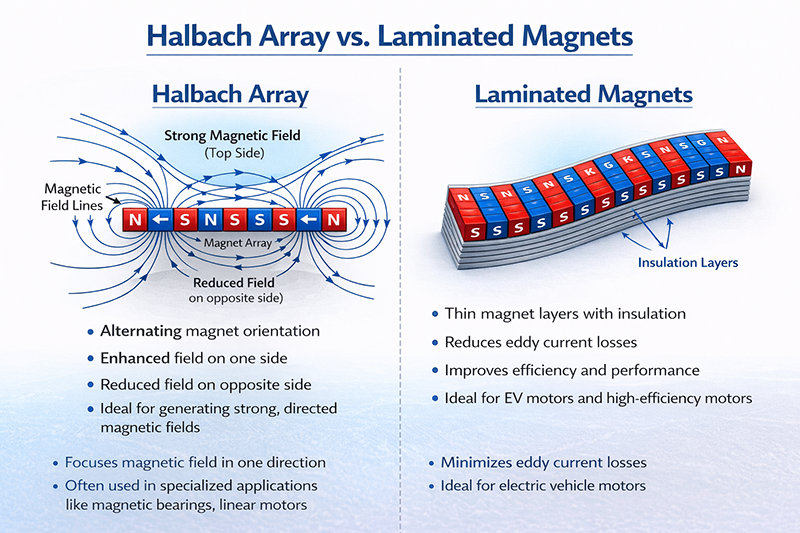
A Halbach array is a special arrangement of permanent magnets that concentrates the magnetic field on one side of the array while nearly canceling it on the opposite side . This unique configuration allows you to generate an extremely strong magnetic field on the side you need, with minimal material and virtually no stray field on the back.
How It Works: The Principle of Rotating Magnetization
The principle behind a Halbach array is the rotation of magnetization directions. Instead of aligning all magnets with the same pole facing the same way, the magnets are arranged so that their magnetization direction rotates progressively along the array .
For a linear (planar) Halbach array, the typical pattern involves magnets where the poles rotate by 90 degrees for each segment. This creates a "single-sided flux" effect: the magnetic field lines are "folded" to one side, making that side extremely strong while the other side has virtually no magnetic field.
Latest Research: Hybrid Manufacturing and Field Enhancement
Recent research published in AIP Advances (February 2026) has demonstrated exciting developments in Halbach array technology. Scientists at the University of Central Oklahoma and Oak Ridge National Laboratory have successfully tested hybrid manufacturing approaches that combine sintered NdFeB magnets with additively manufactured soft magnet frames .
Key findings from this cutting-edge research include:
Axial field enhancement: Introducing a second ring of soft-magnetic steel elements increased the axial magnetic field by approximately 27% .
Material efficiency: The lateral field enhancement achieved using eight NdFeB cubes combined with 16 steel cubes was comparable to using a full outer ring of 24 NdFeB magnets, despite substantially reduced permanent-magnet content .
Rare-earth reduction: This hybrid approach demonstrates significant potential for reducing reliance on critical rare-earth materials while maintaining competitive magnetic performance .
Advanced Optimization Techniques
Traditional design of Halbach arrays has relied heavily on engineering intuition, but recent advances in numerical methods now enable systematic optimization. Researchers have developed a cardinal basis function (CBF)-based level set method for the design of circular Halbach arrays that can optimize both material distribution and magnetization directions simultaneously . This approach:
Reduces computational cost and accelerates convergence
Enables multi-material topology optimization
Types of Halbach Arrays
Planar Halbach Array: A flat arrangement used in applications requiring a strong magnetic field on one side only. Common examples include refrigerator magnets that only stick on one side and magnetic levitation systems.
Cylindrical Halbach Array: A ring-shaped configuration where magnets are arranged around a cylinder. This design can create a very strong and uniform magnetic field inside the cylinder (or outside, depending on design) for applications such as portable NMR/MRI devices .
Performance Metrics: Torque and Efficiency
In electric motor applications, Halbach arrays demonstrate remarkable performance improvements. According to simulation studies using JMAG software:
Average torque: Halbach arrays achieve average torque values of at least 53.7 Nm compared to 52.7 Nm for conventional parallel magnetization patterns
Torque ripple reduction: The torque ripple drops to 0.138 or less when using a Halbach array, compared to 0.541 for conventional designs—representing a reduction of over 40%
Scalability: Increasing the number of divisions per pole further increases average torque while maintaining low torque ripple
Key Advantages of Halbach Arrays
Stronger Field with Less Material: A Halbach array can generate a magnetic field that exceeds the remanence (Br) of the magnetic material itself.
Single-Sided Field: Ideal for applications where you want magnetism on one side and zero interference on the other.
Compact and Lightweight: Because of their efficiency, Halbach arrays enable lighter and more compact designs in motors and generators.
Design Flexibility: Recent advances in additive manufacturing allow for complex geometries that are difficult to achieve with conventional methods .
Applications
Electric Motors: Enhances torque and efficiency in brushless DC motors with significantly reduced torque ripple .
Magnetic Levitation (Maglev): Used in electrodynamic suspension systems; recent experimental validation shows that modified Halbach arrays with extreme fill factors can achieve higher lift-to-drag ratios and reduced magnetic friction .
Medical Imaging: Used in portable MRI machines and benchtop NMR systems, capable of generating uniform fields for full-body imaging .
Particle Accelerators: Used to focus particle beams in synchrotron undulators and free-electron lasers .
Energy Harvesting: An 8×3 Halbach magnetic array combined with optimized coils produces 3.35 mW power at 15.2 Hz under 0.2g acceleration, yielding a normalized power density of 1950 μW/cm³·g² for IoT applications .
Aerospace: Halbach-based magnetic fields could complement coil-driven systems in rocket launch and recovery, creating launchpads capable of accelerating or decelerating rockets using strong, homogeneous fields .
Part 2: Laminated Magnets – Mastering High-Frequency Performance
What are Laminated Magnets?
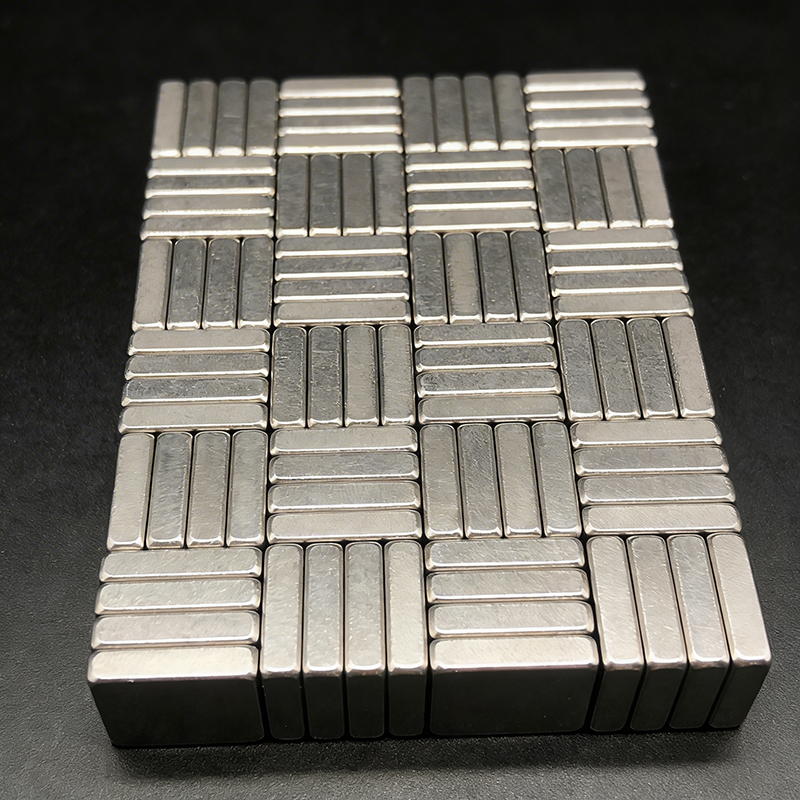
Laminated magnets (also known as laminated magnetic structures or stacked magnets) are components made up of multiple layers of thin magnetic materials stacked together, isolated by insulating layers or coatings to form magnetic circuits . They are not primarily designed to enhance the magnetic field strength in a static sense. Instead, they are designed to preserve magnetic performance under high-frequency or rapidly changing conditions by reducing energy losses.
How It Works: Defeating Eddy Currents
When a solid magnet is exposed to a changing magnetic field (like in an AC motor or transformer), it induces circulating electric currents inside the material called eddy currents. These currents generate heat (energy loss) and can distort the magnetic field, leading to inefficiency and potential demagnetization.
Lamination solves this by:
Cutting the solid magnet into thin slices (laminations)
Insulating each slice with a non-conductive coating or adhesive
This breaks the path of the eddy currents, forcing them to flow within individual small slices rather than in large loops across the entire magnet. This drastically reduces eddy current losses and heat generation.
Additional Performance Mechanisms
Beyond eddy current reduction, laminated magnets offer several other performance advantages :
| Mechanism | Description |
|---|---|
| Reduction of Magnetic Domain Wall Movement Resistance | The layered structure limits the movement range of magnetic domain walls by introducing insulating layers or low-permeability materials between the layers, thereby reducing energy loss during domain wall movement. |
| Optimization of Magnetic Circuit Distribution | The layered structure allows for a more uniform distribution of the magnetic field within the material, reducing local magnetic field concentration that can lead to excessive flipping of domains and energy losses. |
| Matching Material Properties | Different magnetic materials can be chosen for each layer based on their varying hysteresis characteristics, allowing optimization of hysteresis loss while maintaining magnetic performance. |
Which Magnets Can Be Laminated?
Typical Thickness of Laminated Magnets
The thickness of laminations varies by application :
Electric Vehicle Motors: 0.5 mm to 2 mm per layer
Magnetic Separators: 1 mm to 5 mm per layer (adjustable based on separation task requirements)
Key Advantages of Laminated Magnets
Reduced Eddy Current Loss: Significantly lowers energy wasted as heat
High-Frequency Efficiency: Essential for applications operating at high electrical frequencies
Prevents Overheating: By reducing heat, lamination protects the magnet from thermal demagnetization
Improved Motor Efficiency: In electric vehicles, laminated magnets help extend driving range
Enhanced Reliability: Lower temperature rise improves durability and lifespan
Challenges
Complexity of Processing: High-precision equipment required for punching precision, laminations alignment, and insulation treatments
Cost: Processing cost for laminations is higher than that of solid cores, necessitating a balance between performance and budget
Applications
Electric Vehicle Drive Motors: Laminated magnets minimize eddy current losses during high-frequency operation, improving motor efficiency and extending driving range. They also help minimize motor temperature rise, enhancing reliability and durability .
Wind Turbines: Laminated magnets reduce eddy current losses in generators during variable-frequency operation, improving power generation efficiency—especially effective in capturing energy at low wind speeds .
Transformers and Inductors: Used in power converters and solid-state transformers to handle DC and AC flux simultaneously.
Particle Accelerators: Used in booster synchrotrons to minimize field distortions at operating frequencies.
Part 3: Halbach Array vs. Laminated Magnets – Key Differences
While both are advanced techniques for creating "strong" magnets, they solve different problems. Here is a direct comparison:
Part 4: Which One Should You Choose?
The answer depends entirely on your application:
Choose a Halbach Array if:
You need to create the strongest possible static magnetic field in a specific direction while minimizing stray fields elsewhere
You want a compact, lightweight magnetic source
Your application involves precise field control and directional flux
Examples: Designing a portable MRI scanner, a high-torque motor with low ripple, a magnetic levitation system, or an energy harvester for IoT devices
Choose Laminated Magnets if:
Your magnet will operate in a high-frequency environment (like an EV motor running at 10,000+ RPM)
You need to prevent efficiency loss and overheating due to eddy currents
Your application requires long-term reliability under variable loads
Examples: Traction motors for electric vehicles, high-speed spindles, wind turbine generators, and medium-frequency power transformers
Conclusion
Making a "strong magnet" in the 21st century is less about finding a bigger chunk of metal and more about smart engineering.
Halbach arrays manipulate the geometry of magnetization to fold and concentrate magnetic energy where it's needed most. Recent advances in hybrid manufacturing and topology optimization are making these arrays more efficient and accessible than ever, with demonstrated field enhancements of up to 27% using reduced rare-earth content .
Laminated magnets manipulate the physical structure of the material to protect it from the destructive effects of high-frequency currents, enabling the high efficiencies required in modern electric vehicles and renewable energy systems .
Understanding the difference between these two technologies is essential for engineers and buyers looking to optimize performance, efficiency, and cost in their magnetic systems. As research continues to advance—with new developments in additive manufacturing, multi-material optimization, and hybrid designs—the possibilities for creating stronger, more efficient magnets will only continue to expand.