
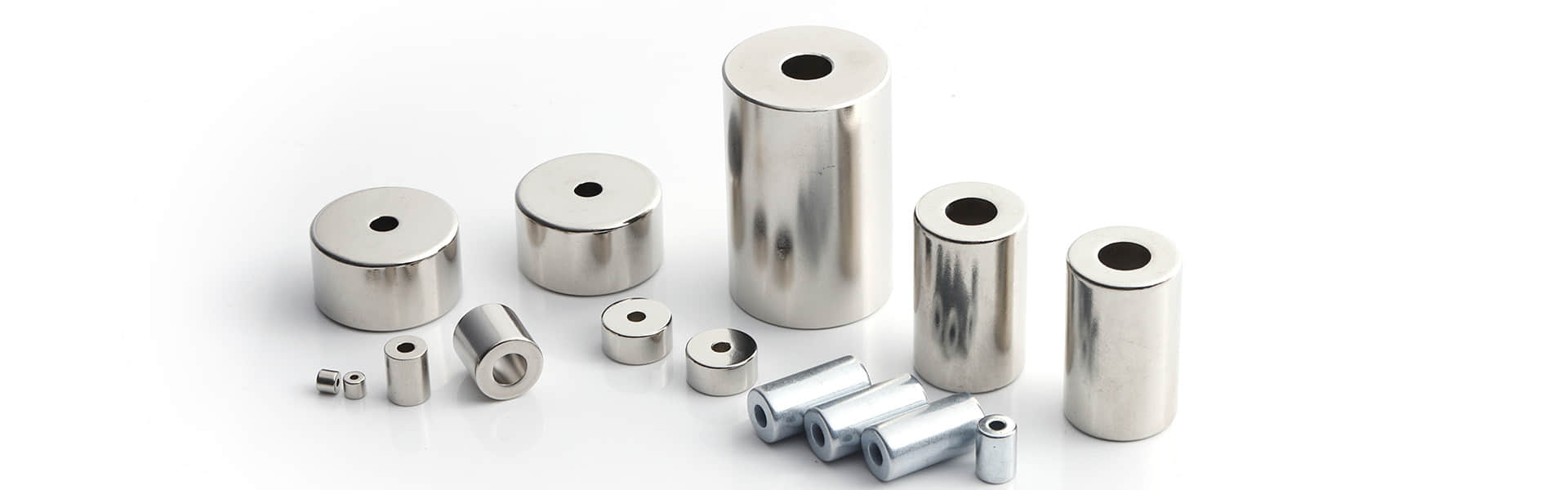
Neodymium Magnets in Magnetic Refrigeration: The Future of Eco-Friendly Cooling
Introduction
Refrigeration and air conditioning account for approximately 15-20% of global electricity consumption. The refrigerants used in traditional vapor-compression systems—hydrofluorocarbons (HFCs) and chlorofluorocarbons (CFCs)—are potent greenhouse gases, thousands of times more damaging than CO₂.
Magnetic refrigeration offers a radically different approach. Instead of compressing and expanding gas, it uses the magnetocaloric effect (MCE) : certain materials heat up when magnetized and cool down when demagnetized. By cycling a material through a magnetic field, you can create a refrigeration effect—without harmful refrigerants, with higher efficiency, and with fewer moving parts.
At the heart of most magnetic refrigeration systems are neodymium permanent magnets, which generate the magnetic fields needed to drive the cooling cycle.
This guide covers:
How the magnetocaloric effect works
The role of neodymium magnets in magnetic refrigeration
Current research and commercial prototypes
Advantages over conventional refrigeration
The future outlook for this emerging technology
Part 1: The Magnetocaloric Effect Explained
1.1 What Is the Magnetocaloric Effect?
The magnetocaloric effect is a physical phenomenon in which certain materials change temperature when exposed to a changing magnetic field.
| State | What Happens | Temperature Change |
|---|---|---|
| Magnetization (field applied) | Magnetic moments in the material align; entropy decreases; heat is released | Material heats up |
| Demagnetization (field removed) | Magnetic moments randomize; entropy increases; heat is absorbed | Material cools down |
The refrigeration cycle:
Magnetize the material → it heats up
Remove heat to the environment (via heat exchanger) → material returns to ambient temperature
Demagnetize the material → it cools below ambient
Absorb heat from the target (the space to be cooled) → material warms back to ambient
By repeating this cycle, a magnetic refrigerator continuously pumps heat from a cold space to a hot space—just like a conventional refrigerator, but without refrigerant gases.
1.2 Magnetocaloric Materials
Note: Gadolinium and its alloys remain the benchmark materials for room-temperature magnetic refrigeration, though they are expensive. Research continues into cheaper, more abundant alternatives.
Part 2: The Role of Neodymium Magnets
2.1 Generating the Magnetic Field
Magnetic refrigeration requires a strong, rapidly changing magnetic field—typically 1-2 Tesla for room-temperature systems. This is where neodymium magnets come in.
Neodymium Iron Boron (NdFeB) permanent magnets are used as the magnetic field source in most magnetic refrigeration prototypes.They are arranged in configurations such as:
2.2 Design Innovations
Key design insight from recent research: For a rotary-type magnetic cooling system, the optimal magnetic duty cycle is approximately 30%, balancing magnetic field strength with thermal-hydraulic performance.
Graded magnet design: By applying graded gadolinium-terbium alloy along the flow direction, researchers have demonstrated more than three times the cooling capacity compared to a pure gadolinium system.
Efficiency improvements: Compared to earlier designs, modern neodymium-based magnetic refrigeration systems require far fewer neodymium magnets while generating stronger fields and greater cooling effects.
2.3 Typical Neodymium Magnet Specifications
| Parameter | Typical Requirement | Why |
|---|---|---|
| Grade | N42 or N45 | High field strength |
| Shape | Arc segments or blocks | For Halbach or coaxial arrays |
| Coating | Ni-Cu-Ni or Epoxy | Corrosion protection |
| Magnetization | Radial or Halbach pattern | Field concentration |
| Temperature stability | SH grade if system operates above 80°C | Field stability |
2.4 Comparison: Permanent Magnet vs. Superconducting Magnet
| Feature | Permanent Magnet (NdFeB) | Superconducting Magnet |
|---|---|---|
| Field strength | 1-2 T | 3-10+ T |
| Cooling required | None (air-cooled) | Liquid helium or cryocooler |
| Cost | Moderate | Very high |
| Complexity | Simple | Complex (cryogenics) |
| Suitability | Room-temperature systems | High-performance research |
| Energy consumption | Zero (static field) | High (cryogenics) |
Why NdFeB is preferred for commercial magnetic refrigeration:Permanent magnets eliminate the need for cryogenic cooling of the magnet itself, making the system simpler, cheaper, and more practical for everyday applications.
Part 3: How a Magnetic Refrigerator Works
3.1 Rotary-Type Magnetic Refrigerator
The most common design for room-temperature magnetic refrigeration is the rotary-type system.
Components:
Rotating magnet assembly – Neodymium magnets arranged in a ring (Halbach array)
Magnetocaloric material – Packed in a bed or regenerator (e.g., gadolinium plates)
Heat transfer fluid – Water or water-glycol mixture
Heat exchangers – Hot side and cold side
Operation:
The magnet assembly rotates, alternately exposing the magnetocaloric material to the magnetic field and removing it
When exposed to the field, the material heats up; heat is transferred to the hot-side heat exchanger
When removed from the field, the material cools down; it absorbs heat from the cold-side heat exchanger
The fluid circulates continuously, pumping heat from cold to hot
3.2 Active Magnetic Regenerator (AMR) Cycle
In an AMR system, the magnetocaloric material also serves as a thermal regenerator—it stores and releases heat as the fluid flows back and forth.
| Phase | Action | Result |
|---|---|---|
| Magnetization | Field applied; material heats | Heat transferred to fluid |
| Hot blow | Fluid flows to hot side | Heat rejected to environment |
| Demagnetization | Field removed; material cools | Material absorbs heat from fluid |
| Cold blow | Fluid flows to cold side | Cold delivered to target |
The AMR cycle is more efficient than simple "batch" magnetic cooling because it recovers heat within the regenerator.
Part 4: Advantages Over Conventional Refrigeration
| Factor | Conventional (Vapor Compression) | Magnetic Refrigeration |
|---|---|---|
| Refrigerant | HFCs, ammonia, CO₂ | None (solid-state) |
| Global warming potential | High (up to 3,000x CO₂) | Zero |
| Energy efficiency | Moderate (COP 2-4) | Potentially higher (COP 4-8) |
| Moving parts | Compressor (high wear) | Rotating magnet assembly (low wear) |
| Noise | Significant | Low |
| Maintenance | Regular (compressor, seals) | Minimal |
| Size | Compact | Currently larger (prototypes) |
| Commercial readiness | Mature | Emerging |
Environmental impact: Replacing vapor-compression systems with magnetic refrigeration could eliminate billions of tons of CO₂-equivalent emissions from refrigerant leakage alone, while also reducing electricity consumption.
Part 5: Current Research and Commercial Development
5.1 Research Prototypes
| Institution/Project | Field Strength | Cooling Power | Status |
|---|---|---|---|
| University of Bayreuth & Mainz | 1.0-1.5 T (NdFeB) | Research-stage | Optimized 3D magnet arrays |
| Various (NIST, Navy) | Up to 7 T (superconducting) | Cryogenic | Reciprocating AMR concept |
| Commercial prototypes | 0.5-1.0 T (NdFeB) | 100-500 W | Limited production |
Key research finding: Recent work has shown that the performance of magnetic refrigeration improves significantly when using graded magnetocaloric materials (e.g., Gd-Tb alloys with varying composition along the flow direction), achieving more than three times the cooling capacity of pure gadolinium systems.
5.2 Commercial Applications (Near-Term)
| Application | Why Magnetic Refrigeration Fits | Timeline |
|---|---|---|
| Wine coolers / beverage chillers | Small capacity, high value, quiet operation | 3-5 years |
| Medical refrigeration (vaccines) | Reliable, low maintenance, no refrigerant leaks | 5-10 years |
| Data center cooling | High efficiency, waste heat recovery | 5-10 years |
| Automotive air conditioning | No refrigerant (no leaks), engine-off cooling | 10+ years |
| Domestic refrigerators | Mass market potential | 10+ years |
5.3 Challenges to Overcome
| Challenge | Description | Current Solutions |
|---|---|---|
| Magnet cost | NdFeB magnets are expensive | Optimized designs using fewer magnets |
| Material cost | Gadolinium is expensive | Research into cheaper alloys (La-Fe-Si) |
| Field strength | 1-2 T limits cooling power | Improved magnet geometries |
| System size | Prototypes are bulky | Miniaturization ongoing |
| Cycle frequency | Slow cycling = low power | Rotary designs improve frequency |
Part 6: The Future Outlook
Market projections:
Global magnetic refrigeration market expected to reach $500M-$1B by 2035
Key growth drivers: refrigerant regulations (Kigali Amendment), energy efficiency mandates, demand for quiet cooling
Technology roadmap:
| Phase | Timeline | Milestone |
|---|---|---|
| Research | Present-2028 | Improved magnetocaloric materials; optimized magnet designs |
| Early commercial | 2028-2035 | Niche applications (medical, wine coolers) |
| Mass market | 2035-2045 | Domestic refrigerators, automotive AC |
Why neodymium magnets will remain central: No other permanent magnet material offers the combination of field strength, cost, and availability needed for practical magnetic refrigeration. Even as magnet designs become more efficient, NdFeB will continue to be the magnet of choice.
Conclusion
Magnetic refrigeration represents a fundamental shift in cooling technology—from gas-based compression to solid-state, magnetically driven cycles.
Key takeaways for engineers and buyers:
The big picture: As refrigerant regulations tighten and energy efficiency becomes more critical, magnetic refrigeration—powered by neodymium magnets—will transition from laboratory curiosity to commercial reality.
XiLaitech supplies high-grade neodymium magnets for magnetic refrigeration research and development. We offer custom arc segments, Halbach arrays, and graded magnet assemblies for prototype and production systems.